The usual Franciacorta? No thanks — try sparkling wine made in Romagna
More and more Romagna estates have made, and are making, big investments and big strides with the classic method, using Romagna’s own native grapes.
Of course, the title is a provocation. We have plenty of excellent Franciacorta that compete with the best Champagne. Still, slowly but surely, Romagna too has been working for some time to have its own excellent classic-method sparkling wines.
More and more Romagna estates have made, and are making, big investments and big strides with the “metodo classico”, naturally using Romagna’s native grapes. Precisely for this reason, I have no intention of comparing them with Franciacorta, which uses other varieties.
But think about it: how many of us, sitting down in a bar for an aperitivo or at a nice dinner, order Franciacorta — only and always? Partly fashion, partly habit, partly so as not to think too much? Come on, burdèl… be honest.
Why not order an excellent Romagna classic-method wine to surprise your guests, to present it as an excellence of our territory, to have a real alternative to the usual Franciacorta, and to spend less — both as customers and as restaurateurs?
Today Sadifruttirossi introduces a great alternative for your dinners, aperitivi and tables: a truly interesting Romagna Metodo Classico.
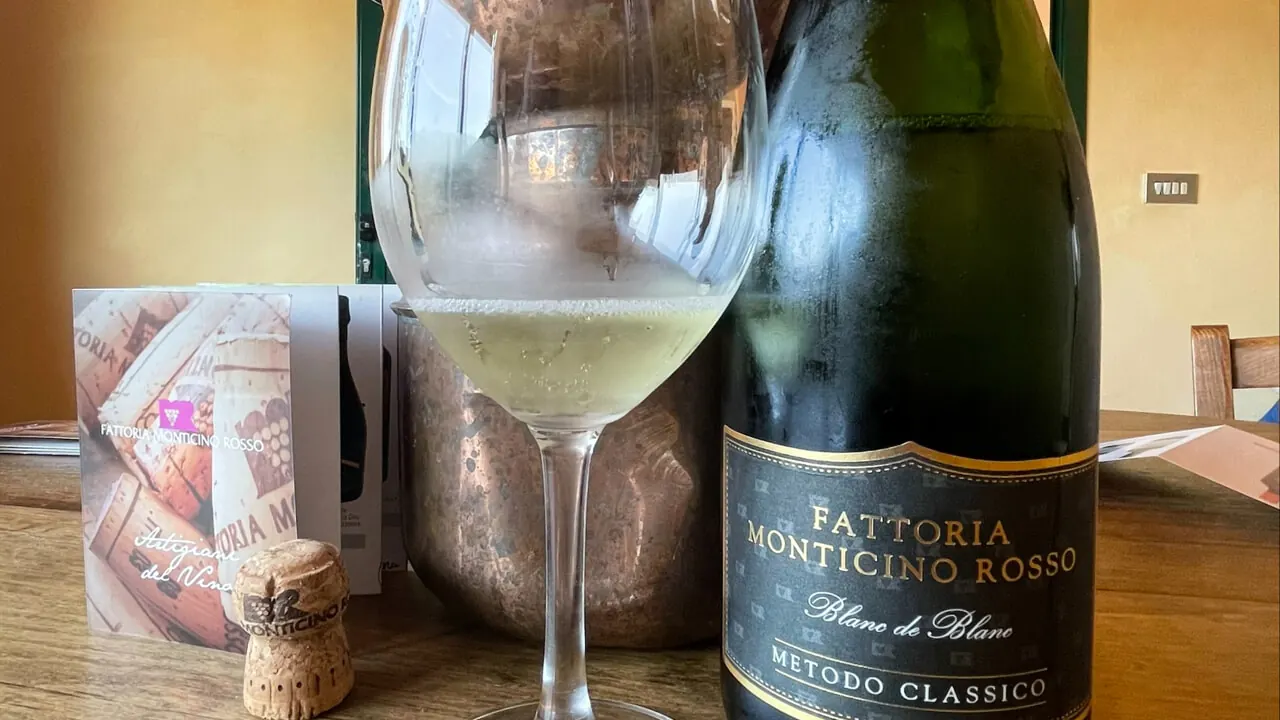
Sadifruttirossi presents the Blanc de Blancs Pas Dosé from Monticino Rosso, the first Romagna classic-method wine made from 100% Albana, which has surprised everyone with its quality and its versatility at the table.
Fattoria Monticino Rosso is a family-run farm, founded in 1965 by Antonio Zeoli. Over the years Antonio was joined by his sons Luciano and Gianni, who run the estate today. The farm lies in the hills of Imola, bordering the municipality of Dozza and the edge of the Romagna known for wine. Beyond it, you’re in Emilia.
For some years Fattoria Monticino Rosso has been carefully transforming its farming to focus on high quality, strictly respecting the soils and climate of the area, using modern techniques and a critical eye on tradition, so as to preserve what centuries of winegrowing in Romagna have handed down.
Its fortunate hillside position supports this project of sustainability and artisanal winemaking, as does the choice to focus mainly on native grapes such as Albana.
From the top of the hill the estate overlooks the valley, with vineyards slowly climbing the surrounding slopes, drawing a landscape of soft shapes caressed by a cool breeze that keeps the grapes healthy. On one side are all the winemaking facilities, tanks and casks in plain view; on the other, the grape reception area, fully covered by a wide roof of laminated wooden beams.
The real surprise, though, is underground, where the beating heart of the winery lies: the fermentation room, the barrique cellar and a bottle-ageing store. The idea of an underground cellar came from the very practical need to minimise their environmental impact and save electricity, but also from a strong wish to create a living space for wine in harmony with nature. In fact, a “garden roof” was built on top, both to preserve the landscape and to create an ideal microclimate inside.
As always, a little simple theory: when we talk about the classic method, we mean the method used to make the famous “bubbles”.
Unlike Prosecco, which is made in large pressurised tanks (favouring quantity), Franciacorta, Trento DOC and Champagne are all made with the classic method, ageing on the lees in bottle (favouring quality). Let’s skip the whole production process, which only interests enthusiasts and which you can read about with a simple online search.
Our Metodo Classico is a Blanc de Blancs (made only from white grapes): 100% Albana di Romagna. It rests on its lees for 36 months before reaching our tables, which gives it its distinctive complexity. Finally, it is “pas dosé” — literally “not dosed”, meaning no sugar is added — a style increasingly popular in Italy, especially among sparkling-wine connoisseurs.
It’s almost the end of August, and at Monticino Rosso the Albana harvest for the Blanc de Blancs has just begun. What strikes you most when visiting the Zeoli family is that the farm is completely self-sufficient in making its Metodo Classico. Every step happens on the estate: harvest, blending, bottling, second fermentation, ageing and finally disgorging.
Here they disgorge “à la volée”. And what does that mean? Disgorging is the stage when the crown cap is removed together with the fermentation residue.
In disgorging “à la volée”, the bottles are opened one by one, by hand, according to tradition. Once the crown cap is removed, the pressure inside pushes out the spent yeasts that have collected in the small plastic cup beneath the cap (the “bidule”), which is expelled too.
At this point, though, I have a brilliant idea for your next gift, to give or to receive (only twenty weeks to Christmas!): an AIS course with the Romagna delegation is wonderful for anyone who wants to learn more — I can’t tell you everything myself! So go on, then… courses start in September and you’ll find them here: https://www.aisromagna.it/corsi/ Be curious — it’s the best thing there is.
If you just have questions for me, advice on which Romagna wine to put on the table, or tips on a Romagna wine list for your customers, write to me on Instagram at the “sadifruttirossi” profile or email sadifruttirossi@gmail.com. I’ll be happy to help you choose and pair.
Tasting Monticino Rosso’s Metodo Classico, vintage 2019, disgorged in 2023, we easily find delightful qualities: brilliant straw yellow turning gold; fine, persistent, pleasant bubbles; mango, peach and apricot on the nose; creamy and dry on the palate, with excellent freshness (a great solution in this heat), great length and depth. A precious, serious wine that calls for a second glass, a third and so on… (don’t get tipsy — drink responsibly).
Today’s pairing?
I would very happily pair Monticino Rosso’s Metodo Classico throughout the meal. It’s great with every dish I can think of — try it from starter to main. It’s the classic wine that “cuts through the fat”, to use yet another Romagna expression. Not with dessert, though: the sacred rule of pairing is that sweet goes with sweet. I also suggest trying it with pizza every Sunday evening. I do drink beer… but I confess I prefer Metodo Classico with a margherita.
The usual serving temperature of 6–8°C is just right. An open secret: if you forget to chill your Metodo Classico and need to cool it quickly, put the bottle in an ice bucket (not too much ice, mind you) and add water and coarse salt. In under ten minutes your bottle will be ready to serve. Ready… let’s drink!