Blanc de Noirs: a sparkling wine from black grapes, in Romagna too
Romagna’s classic-method sparklers still have room to grow, but I promise you can already impress your guests by pairing a local bottle with one of your specialities.
Today Sadifruttirossi returns to the much-debated “metodo classico” (traditional-method sparkling wine) made in Romagna. It was a pleasure — and quite “instructive” — to read all the comments under my previous article on the delicious Blanc de Blancs from the Monticino Rosso estate. I understood, with a smile, that almost everyone prefers the classic-method wines of Franciacorta. They are undoubtedly excellent and fully deserve their place on the podium of Italy’s best. But let’s remember that in Romagna we have different soils for our vines, different grapes, and that our “metodo classico” adventure “has only just begun”, as we say in dialect.
Romagna’s classic-method sparklers will certainly have to grow and improve, but I promise you can already impress your guests by pairing a local wine with one of your specialities. Today I want to introduce an excellent Blanc de Noirs. “And what’s a Blanc de Noirs?” It is a sparkling wine made only from black grapes. Usually that means Pinot Noir, one of the grapes behind Champagne and Franciacorta (“dressed in tails”, as we’d say). Today we taste the Blanc de Noirs from Pertinello, a little Romagna gem made from 100% Sangiovese.
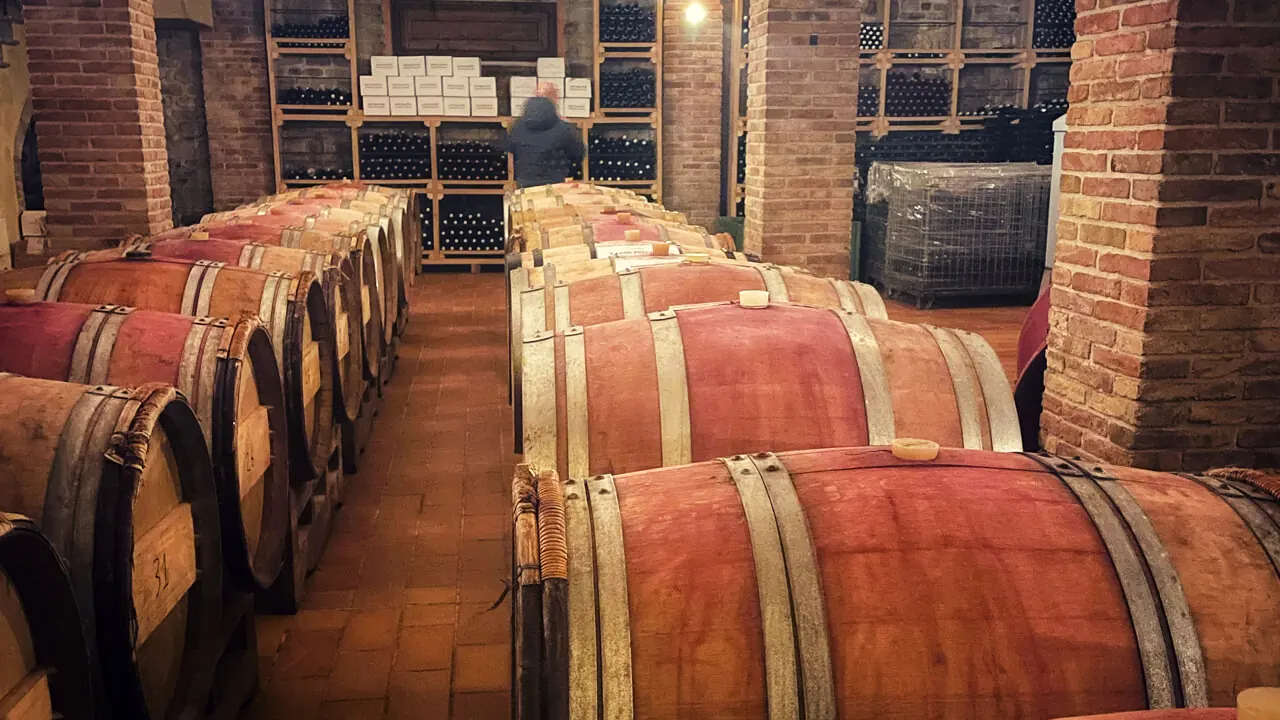
Tenuta Agricola Pertinello, owned by the Mancini family, was founded in 1996 in the beautiful upper Bidente valley, very close to the Foreste Casentinesi National Park. Of its 75 hectares, 15 are vineyards and more than 60 are woodland; the estate sits on the very edge of the municipality of Galeata, a border land that once belonged to the Grand Duchy of Tuscany. The nearby Apennine peaks, constant breezes and wide day–night temperature swings in the warm months favour sustainable farming, and the Pertinello vineyard has been certified organic since the 2015 harvest.
The vines grow at 300 metres on stony soil rich in limestone and clay, in full sun facing south–south-east, constantly ventilated, with big temperature swings and little rain — so vines and grapes stay healthy without special intervention. Between the rows a grassy strip keeps the soil evenly moist and creates ideal humus for natural fertilisation. To raise grape quality, the new vineyards were planted with spurred cordon on a vertical trellis, at high density (6,000 vines per hectare) and low yields (no more than 65 quintals per hectare). The bunches are healthier, with more sugar, polyphenols, anthocyanins and extract.
The estate’s hillside is particularly suited to vines. The grapes for Pertinello’s Blanc de Noirs come from four specific vineyards — Vigna Bassa, Vigna dei Cavalli, Vigna Terrazza and Vigna Casetti — on calcareous clay soils with sand and stones. They are picked by hand at the very start of the harvest, towards the end of September, when they offer maximum fresh acidity. The wine rests on its lees for 24 months and then about three months in bottle after disgorging. Disgorging? Hold on a second — a short lesson on this crucial step in making our sparkling wines. In Italy we call it “sboccatura”; in France, “dégorgement”.
Disgorging removes from the bottle the yeast sediment formed during the second fermentation of the classic method. The French “dégorgement” could be translated as “discharge”. It is a key moment in a wine’s life. After months of ageing, during which the yeasts “eat” the sugar and produce the much-loved bubbles, the wine is cloudy: hold the bottle against the light and you can clearly see yeast particles in suspension that must be removed.
To do so, the bottles are first placed neck down and turned regularly so the yeasts collect in the neck. Then comes the actual disgorging, which can be done cold or warm. The warm method — which you can call “à la volée” if you want to show off — is used only by a handful of small cellars. It is laborious and takes patience and skill: holding the bottle neck down, you remove the crown cap, taking care not to lose too much wine along the way, and all the sediment shoots out. In cold disgorging, invented by Armand Walfard of the Binet house in Reims and patented in 1884, the bottles are placed upside down in a frozen brine at between −15 and −35°C. Because of the alcohol the sediment doesn’t freeze but turns granular, collecting in a small plastic cup under the cap called a “bidule”, which is then removed. The low temperature keeps the carbon dioxide in the wine without loss of pressure.
Back to Pertinello’s Blanc de Noirs: today we taste the 2021 vintage, disgorged in October 2023. It is a “pas dosé”, with less than 3 grams of residual sugar per litre. The term — for the curious as goats among you — means no liqueur d’expédition is added before the bottle is re-corked. I know: you expect a red wine in the glass. But that’s not what Blanc de Noirs means, remember? In the glass it is a beautiful bright straw-to-hay yellow with fine, persistent bubbles. The palate is full and enveloping. The disgorging is very recent and a few more months might bring even more satisfaction, but I promise this Sangiovese sparkler will surprise you. The nose recalls pastry — close your eyes and you’ll think you’ve walked into a bakery — with hints of aromatic herbs and a citrus finish.
Today’s pairing? Drink Pertinello Metodo Classico throughout the meal, from starter to main. It is best with dishes that lean slightly sweet, which the bubbles and freshness of this wine match beautifully. For example, a lovely bluefin tuna or salmon tartare, after opening the feast with a stracciatella risotto topped with raw prawn tartare. Ready? Let’s drink…