A superstar Trebbiano Romagnolo “born” in Piedmont
Today Sadifruttirossi tells a story that sounds almost like a fairy tale: Stefano Bariani at the court of Angelo Gaja in Barbaresco.
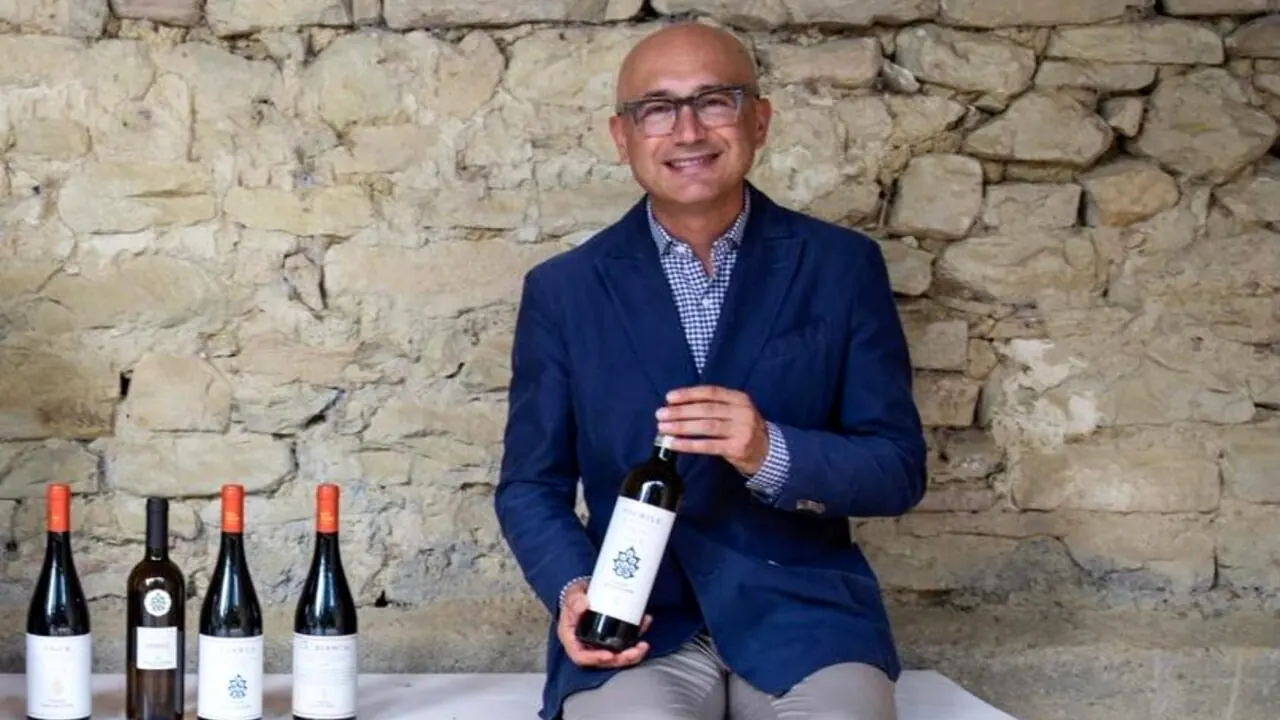
Today Sadifruttirossi takes you to discover a story that sounds almost like a fairy tale. It starts far away, with a dream: a young man fresh out of agricultural college, itching to work a vineyard of his own. But the time isn’t right yet, and so… a pinch of madness — the very madness that will win over one of the most celebrated figures in modern Italian winemaking.
Let’s begin our journey, one step at a time.
Stefano Bariani was born in 1969 in a small village near Ferrara, into a family of farmers and bakers. His grandfather owned land where they mostly grew fruit. From the age of six Stefano spent a lot of time in the fields, running between rows of orchards, vines, wheat and maize. In those years, still unknowingly, he developed a deep sensitivity to nature. The countryside around Ferrara in the 1970s was truly beautiful, unspoilt and very fertile, and people treated the land with great respect. For Stefano the fields were not only where his family worked but boundless spaces to admire flowers, trees and animals. In 1988 he graduated from the agricultural technical institute, choosing viticulture and oenology for his final exams. In 1989 he enrolled in the Faculty of Agriculture at the University of Bologna, graduating with top marks and honours in 1996. To make his life interesting and fulfilling, Stefano knew he had to follow his instinct and his dream of working as an agronomist for a great wine estate, wherever it might be.
In 1997, while studying for his AIS (Italian Sommelier Association) diploma, one of the textbooks Stefano read was “Sorì San Lorenzo: The Making of a Great Wine” by Edward Steinberg. Through it he discovered the Gaja winery and was captivated by the wonderful story and by Steinberg’s descriptions of the landscapes and vineyards.
Who doesn’t know Gaja in Piedmont? A little chat about it: Italian excellence on the world wine stage, “luxury quality”, almost mythical winemaking secrets and know-how. Gaja is internationally renowned for its history and the quality of its wines. Angelo Gaja, with his wife Lucia and their children Gaia, Rossana and Giovanni, has made it a benchmark of excellence in Italy and worldwide. In the charming old centre of Barbaresco, Gaja makes red wines that have become a true cult among enthusiasts — wines of unmistakable class and extraordinary longevity, skilfully combining tradition and modernity. Every sip reveals the innate elegance of these unique bottles.
“Why don’t I send my CV to Angelo Gaja?” Stefano thought, on a sudden impulse. He did, but got no reply. So he took the initiative and phoned the estate himself. They put him straight through to Angelo Gaja, who asked whether Stefano was free on 1 May, a public holiday, and proposed a meeting, saying he was interested in his CV. Stefano accepted without hesitation, and the two met in the Barbaresco cellars for an interview that lasted more than four hours.
Angelo Gaja asked many questions, wanting to understand Stefano’s passion for wine, and told him about the many projects taking shape in those years: new properties in Montalcino (Pieve Santa Restituta), the purchase of the Castle of Barbaresco, vineyards in La Morra (Gromis) and the wish to build a new winery at Bolgheri (Ca’ Marcanda).
At the end of the interview Angelo told him, in a friendly way, that he was mad — but that he liked mad people — and offered him a chance to work for him. Mad, in his view, because Stefano wanted to work in Piedmont, more than four hundred kilometres from home, coming from an area with no wine tradition, and was ready to leave family and home to move to Barbaresco. Angelo Gaja was struck by his determination and gave him a place on his team in September 1999.
His role was personal assistant and secretary. It was this experience that shaped Stefano Bariani, both professionally and personally: he learned discipline, dedication and the sacrifice it takes to reach excellence.
His mentors — Angelo Gaja, Lucia Gaja and the oenologist Guido Rivella — were an important example.
During that time Stefano developed his skills and learned to appreciate the world’s greatest wines, including French, Californian and Australian bottles imported by Gaja Distribuzione. He also learned to speak in public by leading guided tours of the estate. He worked in the cellar following Guido Rivella’s teaching and learned to manage the vineyards with the agronomist. They were seven wonderful, unrepeatable years.
So why did Stefano leave Gaja in 2006? He wanted to test himself and keep growing, putting into practice the many lessons learned in Barbaresco. He wanted to become a true vigneron, interpreting wine and vineyard according to his own sensibility. In short, he gave up a secure job to build his own estate, his own vineyards and his own wines — mainly white wines.
Stefano and his family were looking for a secluded place in Romagna with vineyards, but above all immersed in nature, surrounded by woods and rivers, with few people around. On 18 June 2008 — the same day a beautiful baby girl, Biancamaria, arrived — the happy adventure of Fondo San Giuseppe officially began.
Fondo San Giuseppe is in Brisighella, an enchanting village in the Romagna Apennines. The estate lies at 400 metres above sea level in the wonderful Valpiana subzone: a plateau entirely surrounded by woods, with remarkable biodiversity.
The soils have a complex make-up, with plenty of silty clay, limestone and marly stones. These features, together with rich organic matter, help Stefano’s vines thrive.
The property includes 5 hectares of vineyards and 11 of woodland. The woods are essential to the health of the ecosystem, producing plenty of oxygen for cleaner, healthier air. The Lamone river runs along the whole Brisighella valley, only a few hundred metres from the vineyards, providing the humidity that in some years allows the more delicate varieties, such as Riesling and Albana, to develop Botrytis cinerea (“noble rot”), giving the wines their typical hints of petrol and flint. For more on noble rot, read the article “The Romagna of wine you don’t expect: noble rot on our tables”.
The 400-metre altitude and the north-facing vineyards create wide day–night temperature swings: ideal conditions for locking fruity and floral aromas into the wines.
The estate’s philosophy sees wine as a spontaneous fruit of the earth, reflected in production methods based on sustainability and minimal technical intervention. Stefano chose Brisighella because it is enchanting, set in a still unspoilt valley where nature has kept its beauty intact, with the river, the hills, olive trees and many woods.
He bought Fondo San Giuseppe in 2008, and since then he and his family have devoted all their energy to farming and enhancing this unique land. For Fondo San Giuseppe, organic farming is not a convenient choice but a real creed. From the start Stefano has championed the farming of the past, when artisan farmers read the land with ancient knowledge handed down for generations, long before the fertiliser and pesticide industry existed.
Fondo San Giuseppe produces organic wine certified by Suolo e Salute, a choice that reflects their commitment to a sustainable approach that respects the environment.
Fondo San Giuseppe is home to the Trebbiano “Tèra”: Romagna excellence in the world of wine — and of white wine — with many awards for its structure and complexity. (Unusual for a Trebbiano, right?)
“The success of this bottle is the success of a project,” Stefano tells us. For years Trebbiano in Romagna was mistreated and manipulated; the aim was to hide the soul of this grape, which had become a byword for poor quality — plonk, in short.
So here, tasted for Sadifruttirossi, is one of the whites that best expresses the estate’s philosophy: Tèra (2022), a perfect meeting of Trebbiano della Fiamma and mountain Trebbiano; a sublime interpreter of that rugged valley rising along the Tuscan-Romagna Apennines, whose name already holds a piece of it. In Romagnol dialect “tèra” means earth, reminding us that if we respect the land it will always repay us, and if the vineyard is managed naturally, without forcing, the result will certainly be an expressive wine. Good? Who knows — but with this Trebbiano, awarded 4 Viti by AIS again in 2023, we can taste the quality loud and clear.
The grapes come from two small north-facing vineyards at 400 metres, right against the woods, together less than one hectare. The first was planted in 1970, the second ten years later.
Thanks to the altitude, exposure and poor soil, yields are truly low — about 20 quintals per hectare, a quarter of the average for a white — and only a very small number of bottles are made. Tèra keeps the variety’s typical notes of white-fleshed fruit, white flowers and aromatic herbs; on the palate it is extremely fresh and mineral, with a body already well balanced and ready for the table, though a few years in bottle will add complexity and elegance.
Tèra is an organic Trebbiano with character and a very bright straw colour. It ferments in steel and matures six months in wood and another six in terracotta. Its freshness gently cleanses the palate, with clean, very elegant hints of white fruit and flowers such as chamomile and jasmine, and iodine and citrus notes on the finish.
Tèra is one of the most important references among the whites of our area, and for a Trebbiano Romagnolo I’d say Stefano has translated his “Piedmontese” lessons brilliantly. Congratulations, Stefano — to you and to your madness (which Angelo Gaja liked so much).
Today’s pairing?
Today we pair our magnificent Trebbiano Romagnolo Tèra with dishes from Romagna’s seafaring tradition. Let’s make a sea bass baked in salt, with roast potatoes on the side. Or a seafood risotto (shelled, please) will be a great match for today’s star: persistence and savouriness will be well balanced. Ready? Let’s drink… and by the way, happy new year to everyone from Sadifruttirossi. I wish you a fantastic 2024, full of “cin cin”!