“Vineyards above the badlands”: a lunar landscape for out-of-this-world wines
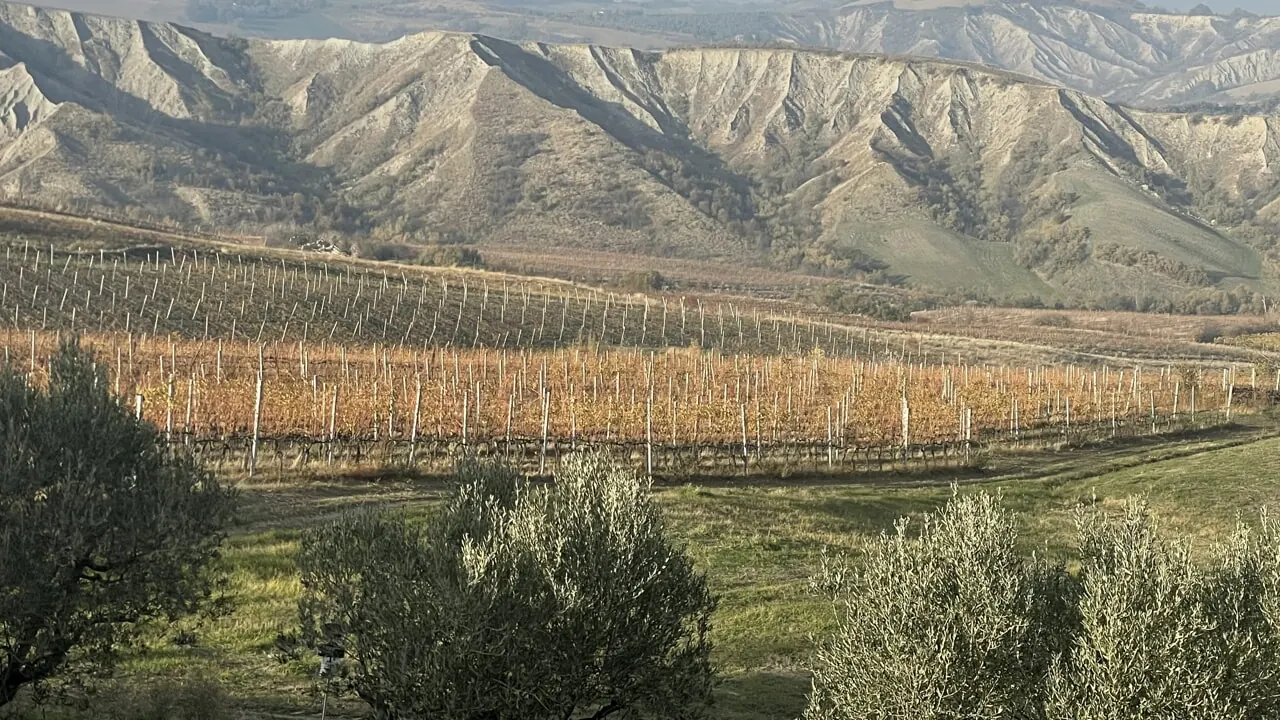
In this magnificent area, on the Bagnolo hill — the highest between Castrocaro Terme and Terra del Sole — in a place that looks like a lunar amphitheatre, stands Marta Valpiani.
Monsignor Enzo Donatini describes the Castrocaro – Terra del Sole area like this: “Where the last hills gently close the valley, a building site swarms like a busy beehive. Diggers, ploughmen, stonecutters, kiln workers, masons, carpenters — what are we waiting for? We are building a fortress city, a new city: the ‘City of the Sun’.
It will be girded by mighty bastioned walls; you will enter through two gates beneath two castles, and two broad streets will lead to the square, the heart of the city: here the palaces and the church, and all around the green of the countryside, above the blue and the sun — a sunlit city that reflects harmony, space and splendour. So said a master builder: and in his eyes I read the image of a dream already turned to stone.”
In this magnificent area, on the Bagnolo hill — the highest between Castrocaro Terme and Terra del Sole — in a place that looks like a lunar amphitheatre, stands Marta Valpiani.
Castrocaro has a very varied landscape, with big differences just a few metres apart: to the north, blue clays and spungone rock, opening towards the Adriatic; to the south, red iron-rich clays, spungone and limestone alternating with golden sands and sandstone, all overlooking the cooler valley of the Montone river.
Over it all lies a strong marine, saline imprint from the salt-bromine-iodine springs of Castrocaro’s spa, which marks all of Elisa’s wines — and which we find very clearly in the glass today.
Salt-rich soils and wonderful badlands (calanchi) with a breathtaking view. Limestone, sand and spungone make up the subsoil of this marvellous Romagna estate.
Today the estate is run by Elisa Mazzavillani, the daughter — a superwoman, a gifted farmer with a passion for botany and geology. Her bond with plants and her love of art and drawing don’t go unnoticed: each wine has a beautiful label featuring a painted flower. “It’s Christmas”: give a gift that is both elegant and delicious — choose Elisa’s wines and you’ll make a great impression. Elisa loves wine, and when she talks about it she draws you in. In her words: “I love wine because it is the history and the roots of these places, because, like a song, it reminds you of special moments. Every day I share a new way of interpreting farming, between beauty, balance and naturalness.”
Marta Valpiani’s symbol is the butterfly. Over time, the butterfly has somehow shown Elisa the way, in art and in life. It’s a nod to Tonino Guerra’s poem “The Butterfly”: “Happy, truly happy I have been many times in my life, but most of all when they freed me in Germany and I stood looking at a butterfly without wanting to eat it.”
Over the years the estate has worked to increase biodiversity as much as possible, planting trees, shrubs, lavender, broom and other honey plants. This has brought a multitude of butterflies, beetles, wild bees and, in turn, insect-eating birds — essential to the estate’s biodynamic approach (not yet certified).
Marta Valpiani covers about 34 hectares at around 300 metres. Viticulture is natural, in a magnificent and complex ecosystem, and all work is done by hand. As respectful interpreters of the Castrocaro area, caring for the land is at the centre of daily life for Elisa and her team. They follow biodynamic principles, taking into account the seasons and the lunar cycles, and grow only native varieties: Albana, Sangiovese and Trebbiano Romagnolo. Marta Valpiani wines are artisanal, the fruit of experience, travel and above all sharing with other producers. To make special wines that express the territory, each vineyard is vinified separately. In the cellar, work is guided by respect and time, with the sole aim of preserving without ever overpowering — following and supporting the grapes’ natural inclination.
Marta Valpiani’s wines are simple, vertical, energetic and alive. The cellar is small and functional, with very little technology. Elisa doesn’t much like the word “soft and plush”, nor wines with too many flavour “reflections” from oak (vanilla? no thanks). Fermentations are spontaneous, in small steel vats, without temperature control, so they unfold as naturally as possible. The whites age in concrete; the reds partly in concrete and partly in large oak casks, to preserve the integrity of the fruit and the fragrance of the flowers. The goal is to add nothing — but also to take nothing away.
Today Sadifruttirossi introduces one of Elisa’s finest: a 100% Sangiovese that expresses Castrocaro and its extremely saline terroir — limestone told through spice. We taste Rio Pietra 2019, in my view the ultimate expression of Castrocaro Sangiovese. Rio Pietra comes from three crus — Casalinetto, Casalino and Campacci — all on mainly red, iron-rich clays, limestone and spungone, which, as you’ve learned in earlier episodes, is a particular calcareous sandstone that forms the Romagna hills from Bertinoro to Castrocaro Terme, via Meldola and Predappio (from the dialect “spugnò”, for its “spongy” look).
With the 2019 vintage Marta Valpiani Rosso changed its name to Rio Pietra and became a Castrocaro Sangiovese from the subzone. Why this name? It comes from a small stream of iron-rich water next to Podere Casalino, where the soils are red and ferrettised — that is, rich in iron oxide. The Rio Pietra is a tributary of the Montone; it rises on the Bagnolo hill, runs for 2.2 km and crosses the century-old Sorgara Park, a striking spot where in 1924 a new spa opened using three different mineral waters: Salutare, Gigliola and Ferruginosa. The springs were discovered by Michele Savelli, from Modigliana but living in Castrocaro, who from 1919 devoted himself to finding this ancient aquifer.
More than 100 days of maceration on the skins. Why, you ask? This Sangiovese has beautifully thick skins, and the long maceration releases every “extra” they can give, rounding the tannin a lot — that odd persimmon-like sensation I told you about. (Wink.)
Spontaneous alcoholic and malolactic fermentation in steel. Three years of ageing: the first year half in concrete and half in large cask; then, blended, it rests in concrete for the second year, and spends the last year in bottle before reaching our tables.
Marta Valpiani’s Rio Pietra is a great classic, splendidly interpreted. Try it. On the palate you’ll clearly taste its savouriness (remember the salt-bromine-iodine springs that shape the soils?) and its iron-like character (remember those red clays?), which balance a very enjoyable drink.
Today’s pairing?
This week too, let’s come up with a good pairing. Bring our Castrocaro Sangiovese to a serving temperature of about 16°C and put it on the table with pride, because besides being delicious the bottle has a lovely label with Elisa’s drawing of a stunning poppy. I don’t recommend chilling it much: since it isn’t stabilised, it may throw a light tartrate deposit (technical details that don’t matter to us, and that don’t affect the quality of the wine, though they might not look pretty).
Let’s cook a nice spicy chicken curry. Don’t be fussy… with Rio Pietra it will be balanced and perfect for an easy but romantic dinner at home. Or head up into the hills to a trattoria for rich tagliatelle, Sangiovese and a pork mixed grill.
A tip from the Sadifruttirossi travel agency (wink): in front of the Marta Valpiani estate, besides a wonderful view to enjoy while you taste the wines, there’s a lovely, easy trek called “Rio Cozzi”. You won’t regret it. Follow us on social media #sadifruttirossi — come on then, burdèl…